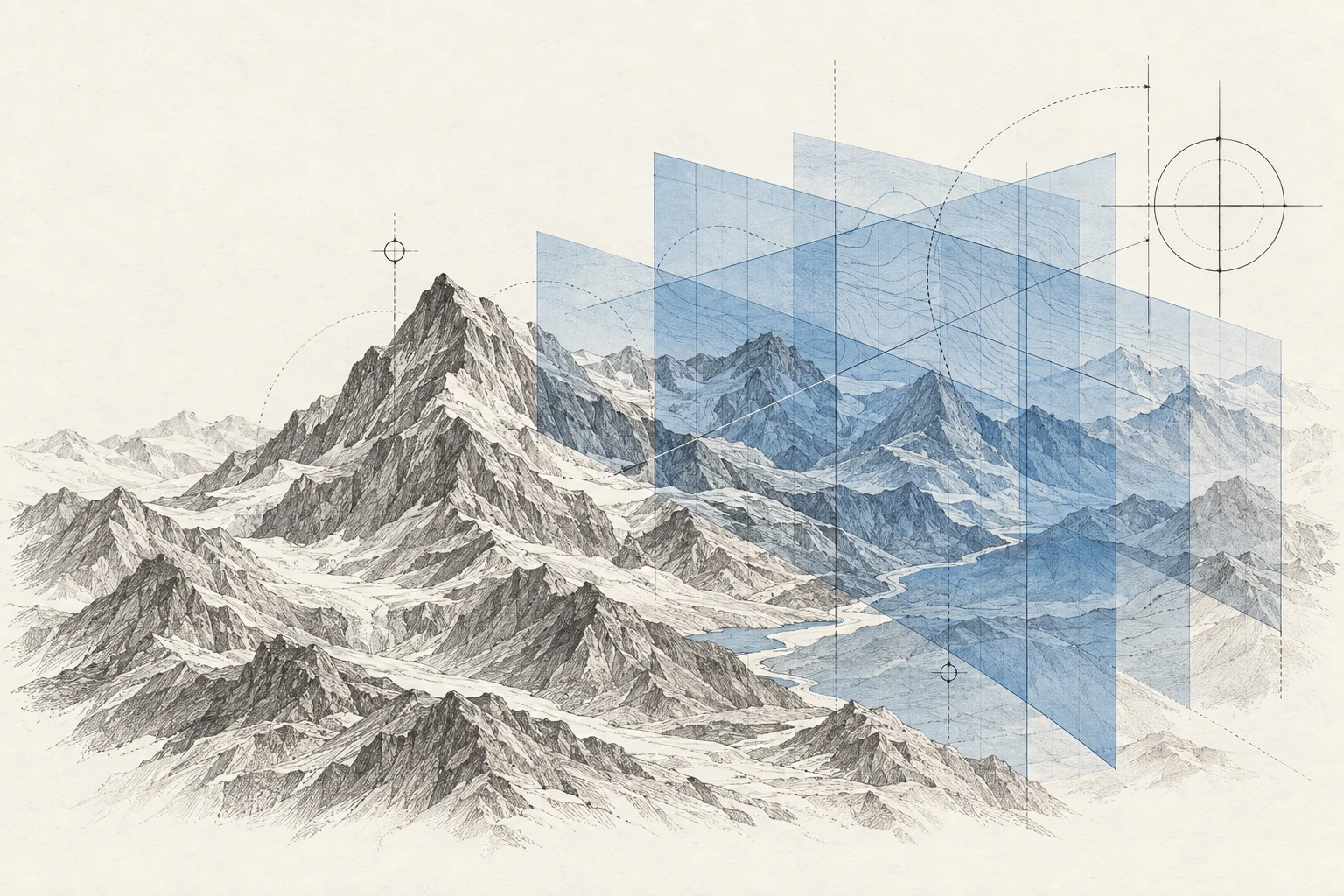
A map helps us
find the way.
But it isn’t
the place.
There's a reflex in product work — in all organizational work, really — to make things legible. Readable. Parsable at a glance. We flatten complexity into dashboards, reduce nuance to bullet points, compress living systems into two-by-two matrices. And most of the time, this is fine. Necessary, even. You can't run a company on vibes alone.
But there's a point where the drive toward legibility stops serving clarity and starts destroying it. Where the map becomes so clean that it no longer resembles the territory. Where the summary is so crisp that it says nothing at all.
The Seduction of the Simple
James C. Scott wrote about this in Seeing Like a State — how governments, in their drive to make populations legible, would flatten local knowledge, rename villages, impose grid patterns on organic cities. The goal was always efficiency, control, understanding. The result was often catastrophe.
We do the same thing in product design, just at a smaller scale. We take a rich, complicated user behavior and reduce it to a funnel. We take a team's messy, productive creative process and flatten it into a linear workflow tool. We take a relationship between a person and a piece of software and reduce it to a satisfaction score.
Each of these translations loses something. And what's lost is usually the thing that matters most.
What Gets Lost
The problem isn't simplification itself. Simplification is a tool, and like any tool, it has appropriate and inappropriate uses. The problem is when we mistake the simplified version for the real thing. When the dashboard becomes reality and the thing the dashboard measures becomes an afterthought.
I've watched teams optimize metrics that were supposed to be proxies for user happiness, long after those metrics stopped correlating with anything meaningful. The legible version — the number going up — replaced the illegible reality of whether people actually found the product useful.
This is the trap. Legibility feels like understanding, but it's often just the appearance of understanding. And the appearance of understanding is more dangerous than honest confusion, because it stops you from asking questions.
Holding Complexity Without Drowning in It
So what's the alternative? Not illegibility for its own sake. Not complexity worship. Not the kind of intellectual posturing that refuses to explain anything clearly because clarity feels beneath you.
The alternative is what I'd call honest translation. It's the practice of simplifying while acknowledging what you've left out. Of building dashboards that include a section for what they can't measure. Of writing summaries that name their own blind spots.
The best systems I've worked on do this. They present clean interfaces while maintaining access to the mess underneath. They give you the summary and the source material. They let you zoom in.
Making things easy to understand is valuable. But understanding itself — real understanding — is rarely easy. The best we can do is build systems that respect that tension instead of pretending it doesn't exist.