492 → 30,517
September 2025 to August 2026. The rounded multiplier compares the two monthly endpoints, not cumulative traffic.
Read the acquisition record ↗Following your local clock · Daylight
Warm ivory · charcoal · open sky
Local time, no location access. Choose a stop to keep that atmosphere.
A more
curious
tomorrow
 Systems / experience / human context
The pieces matter.
So do the connections.
Connecting discovery, publishing, internal operations, and marketplace intelligence across an occupational health platform. A study in how the digital and physical experience fit together.
The original case study recorded growth in discovery and marketplace activity, alongside reuse of the interface system. These are reported historical results—not live counters or an independent re-audit. The repository scope includes my September 2026 update below.
September 2025 to August 2026. The rounded multiplier compares the two monthly endpoints, not cumulative traffic.
Read the acquisition record ↗The original marketplace study reports 1,859 orders versus 88 in the prior trailing period. This is platform activity, not an individual attribution measure.
Read the marketplace record ↗Repository scope updated by Evelyna, September 23, 2026. Engineering teams delivered the shared library and downstream implementations. The retained study records the earlier 29+ scope.
Read the propagation record ↗The work and the reported growth occurred within the same organization; that does not isolate the causal effect of one person or one design decision. The retained studies contain the original evidence labels, comparisons, and commentary. The September 2026 website capture preserves an experience, not proof of these historical outcomes.
Original three-dimensional repository orbit. Nodes illustrate pattern reuse; they are not a repository inventory or live synchronization.
Original working studies · Historical figures and commentary are retained, not a live operational feed or a new audit. Evidence labels and contribution boundaries remain attached to the work.
Repository scope update · 30+ as reported by Evelyna on September 23, 2026. References to 29+ below belong to the original study; its earlier audit labels do not establish a new audit of the updated count.
BlueHive’s public website, internal operations, published research, and event presence are different encounters with the same organization. Designing each in isolation misses the work happening between them.
My work connected interface patterns, information architecture, operational tools, and brand expression. The question was not simply how each artifact looked, but how it helped the next person understand, decide, and act.
Start with the person coordinating the next step.
An employer needed to understand a testing requirement, find a suitable clinic, arrange an appointment, and know what happened next. The coordinator on the other side needed usable intake information, dispatch queues, and a clear view of order status. A better discovery page alone could not resolve that whole journey.
My remit crossed those boundaries: public information architecture, reusable interface patterns, internal CRM interfaces, publishing operations, and the translation of marketplace knowledge into a benchmark report and event presence.
I approached the work as a connected system. The public experience needed to help people choose and act; the internal experience needed to support the people carrying that action through.
Original working studies · Historical figures and commentary are retained, not a live operational feed or a new audit. Evidence labels and contribution boundaries remain attached to the work.
The artifacts came from a set of connected choices: how to publish, how to coordinate, and how to make a useful pattern reusable.
Provider directories, state hubs, and compliance guides needed consistency without becoming identical pages.
I built a shared vocabulary of tokens, components, content schemas, and page templates. Contributors could work within repeatable structures instead of treating every new requirement as a separate design project.
Inspect the component and template study ↗Public demand still had to become clinic coordination. A completed form was the beginning of an operational task, not the end of the experience.
I designed and built the internal CRM interfaces, data tables, and dispatch queues, connecting employer intake with the information coordinators needed to route and follow an order.
Read the internal operations study ↗The public website and internal tools addressed different tasks, but some of their interface problems were shared.
Public-web patterns informed the core product rebuild. Engineering teams formalized components and token schemas from the internal CRM into a shared corporate UI library.
Trace the patterns and contribution boundaries ↗Select a part of the map, then compare the paired evidence beneath it. These are editorial connections between artifacts, not a measured sequence of events.
BlueHive / System map
An editorial reading of the work—not a measured process model.
Compare the homepage’s entry points with the detail on a single service page. The connection to inspect is the shift from introduction to a practical next step.
Public screenshots: September 23, 2026 archive · Later content may be present; not evidence of authorship of every captured page.
Original working studies · Historical figures and commentary are retained, not a live operational feed or a new audit. Evidence labels and contribution boundaries remain attached to the work.
Repository scope update · 30+ as reported by Evelyna on September 23, 2026. References to 29+ below belong to the original study; its earlier audit labels do not establish a new audit of the updated count.
Begin with a decision, then inspect its visual expression. Original archive captures sit alongside explicitly labeled component studies; the two are not interchangeable evidence.
ABCDEFGHIJKLMNOPQRSTUVWXYZ
abcdefghijklmnopqrstuvwxyz
0123456789 & @ ? !
Archived tokens shown as design specimens—not a claim that every captured page uses an identical implementation.
Illustrative interface fragments—not original product screenshots. Inspect the preserved website for the original rendering.
Original working studies · Historical figures and commentary are retained, not a live operational feed or a new audit. Evidence labels and contribution boundaries remain attached to the work.
Repository scope update · 30+ as reported by Evelyna on September 23, 2026. References to 29+ below belong to the original study; its earlier audit labels do not establish a new audit of the updated count.
Start with one of these four pages, or explore all 84 saved public routes. Scroll, follow local links, and open the main menus without leaving the portfolio or relying on the live site.
Public pages captured September 23, 2026 · Original public content, locally reconstructed menu behavior. Not a complete application backup or a claim that all captured content dates to my project period.
Original public pages preserved September 23, 2026, rendered locally for these thumbnails. Not every captured page dates to my project period. Proprietary BlueHive content; no open license asserted. Capture provenance ↗
Original working studies · Historical figures and commentary are retained, not a live operational feed or a new audit. Evidence labels and contribution boundaries remain attached to the work.
The original introduction and the mobile UI announcement: two ways into the employer, provider, and employee experience.
Direction, script, voiceover, animation, video design, and the mobile product design featured in the film.
BlueHive: An Introduction · 1:20 · Original 2023 publicationPublished by BlueHive on December 20, 2023. Preserved locally with permission confirmed by Evelyna on September 23, 2026. English captions are YouTube-generated and may contain errors. Product claims, pricing, and network figures describe the original publication, not today’s service.
Original publication ↗Preservation record ↗Created by Evelyna Bellamy in April 2024 to announce BlueHive’s new mobile UI.
Mobile UI announcement · 0:36 · Created April 2024Originally created in April 2024, as confirmed by Evelyna. Later reused as the opening of BlueHive’s 60 Second Drug Screening Challenge webinar, published on April 3, 2025. This 36-second copy is preserved locally from that archived upload, with original audio. English captions are YouTube-generated and may contain errors. Interface details and product claims reflect the original publication.
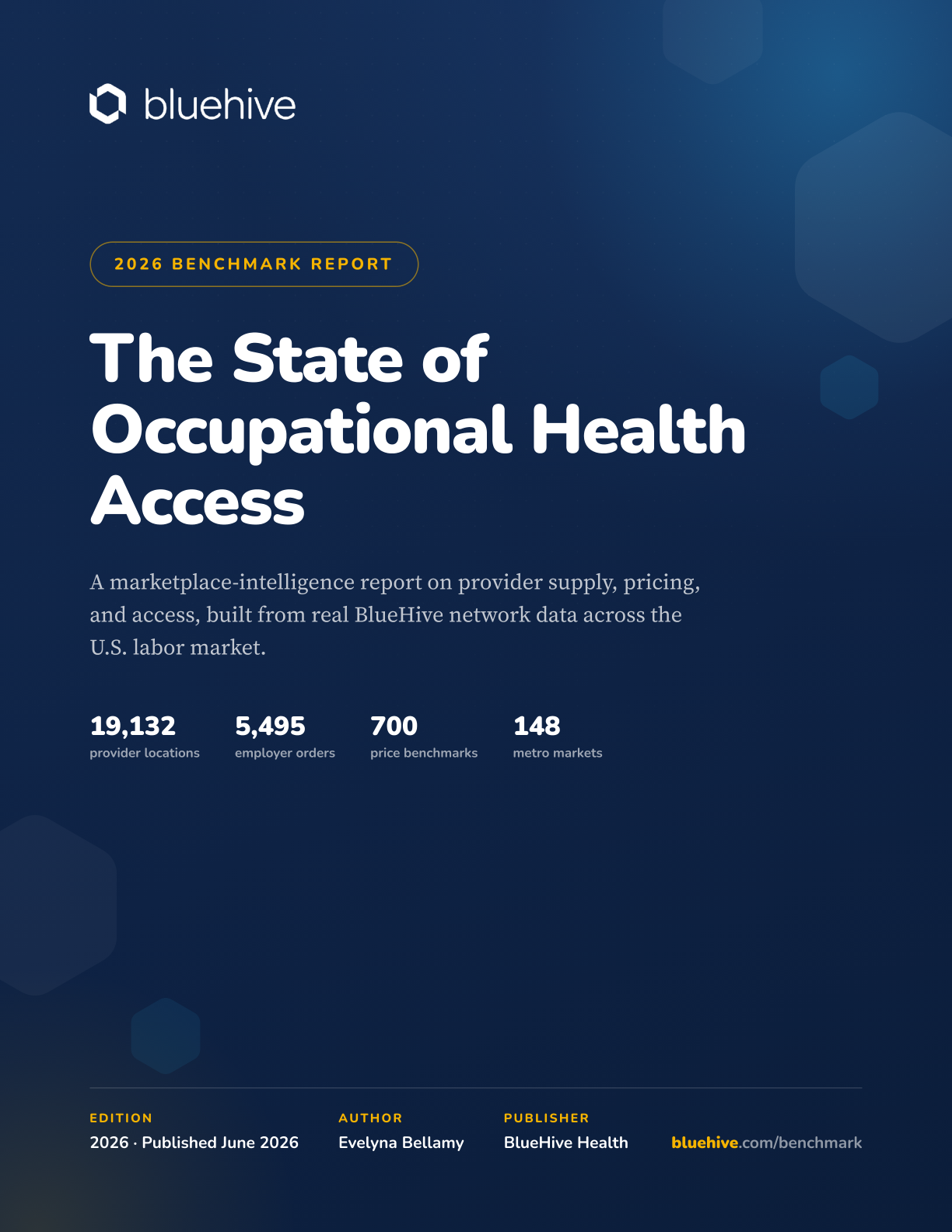
Later webinar publication ↗Preservation record ↗I authored, modeled, and designed the benchmark report to turn marketplace knowledge into something others could read, question, and use. Its original scope includes 19,132 clinic facilities; the preserved pages carry the study’s findings and methodology.
Original WebGL clinic constellation. Dots illustrate the network; they are not clinic addresses or measured regional density.
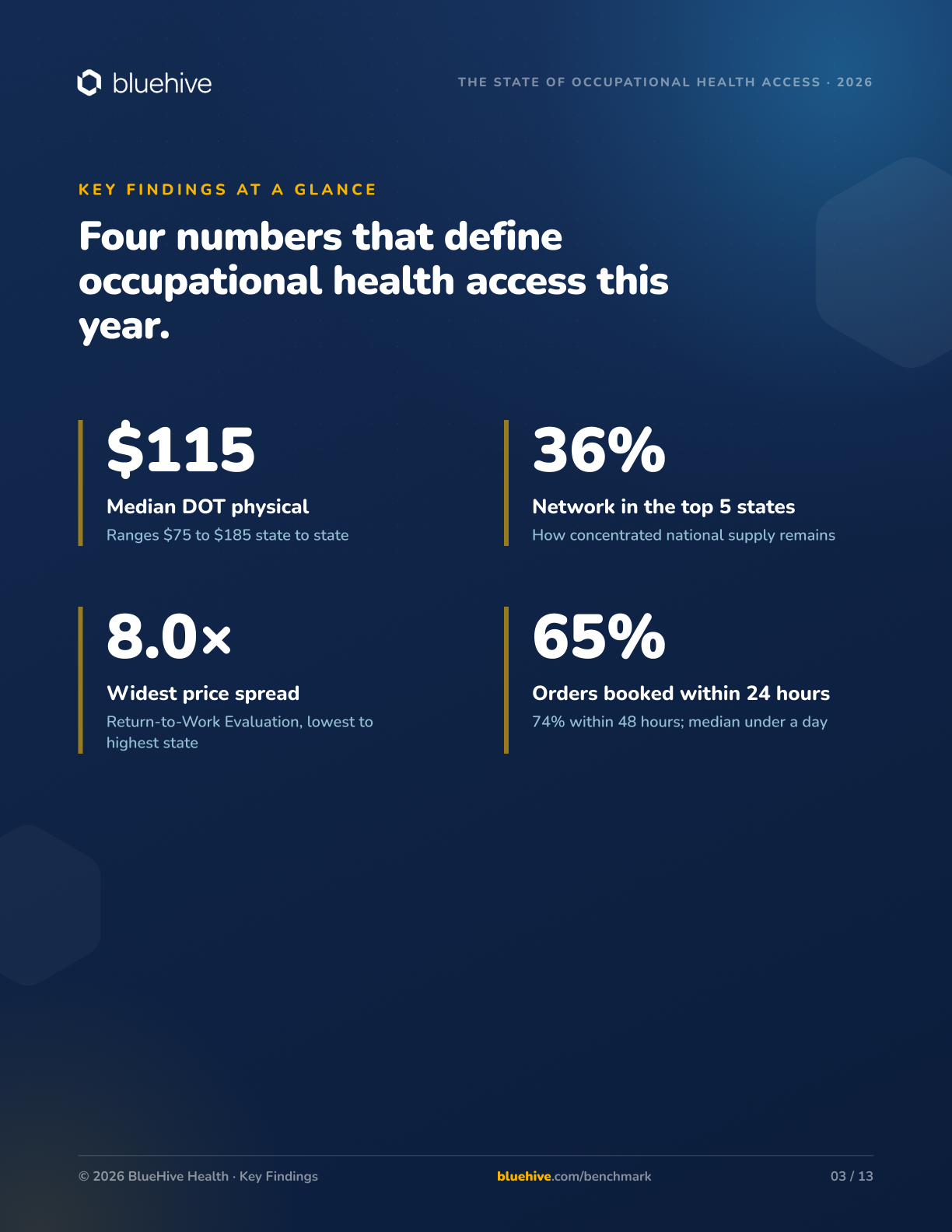
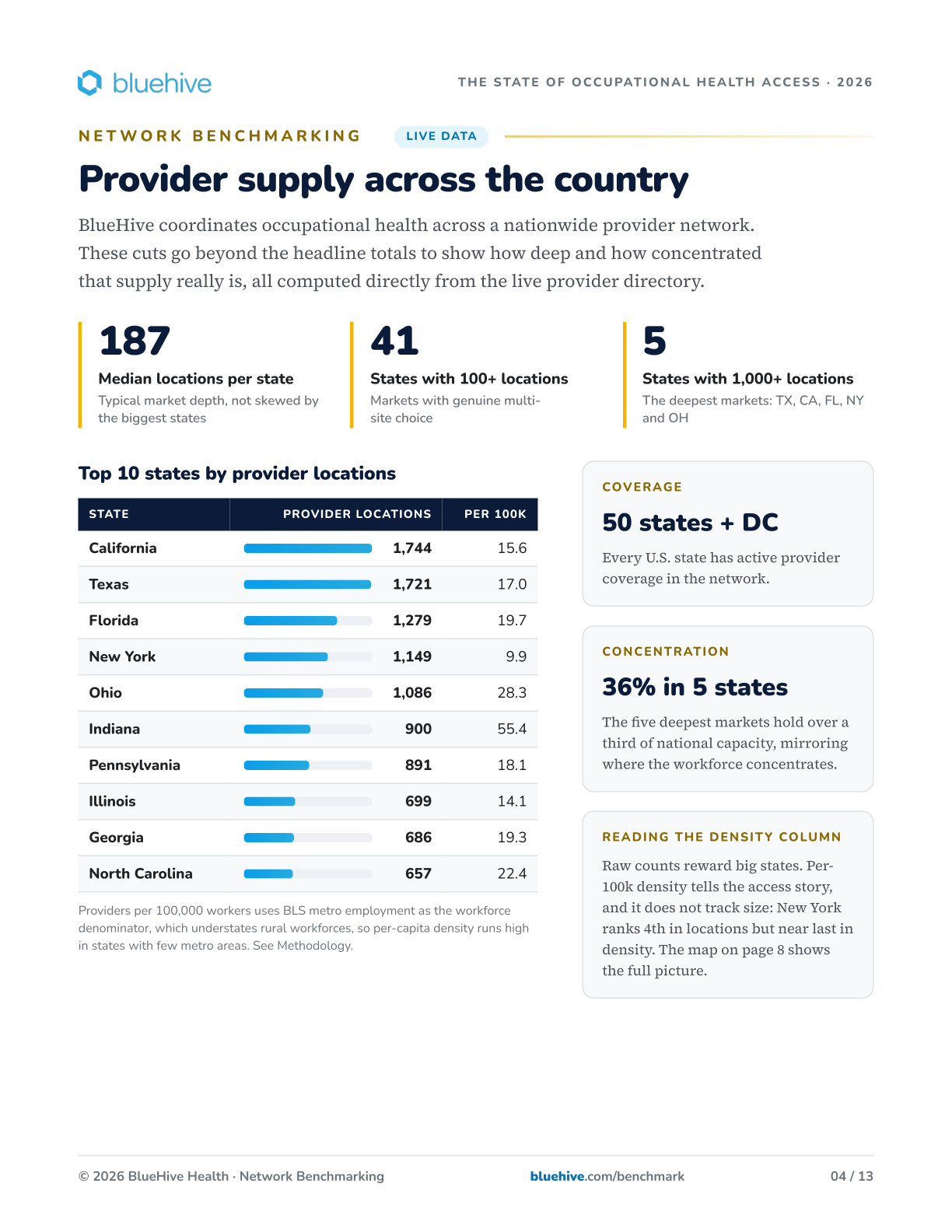
Thirteen original pages. Read the publication, then look beneath the layout: search, magnify, compare spreads, or open the author’s notes and evidence layers.
Original report pages and existing commentary are preserved. Labels describe the archived study, not a live data connection; this redesign does not independently validate its findings.
My role / Report authorship, modeling, and editorial layout.
Preserved from the previous case study. These are historical presentation values, not current prices or a live operational feed. Consult the report for methodology and scope.
Cross-network price distribution across 700+ market rate models
I led the team bringing BlueHive into the tradeshow environment, coordinating messaging, graphic production, vendor logistics, and execution.
The design challenge was continuity across media: a backdrop had to begin a conversation, while collateral and the digital display gave that conversation a next step. Inspect the four details or enlarge the photograph.
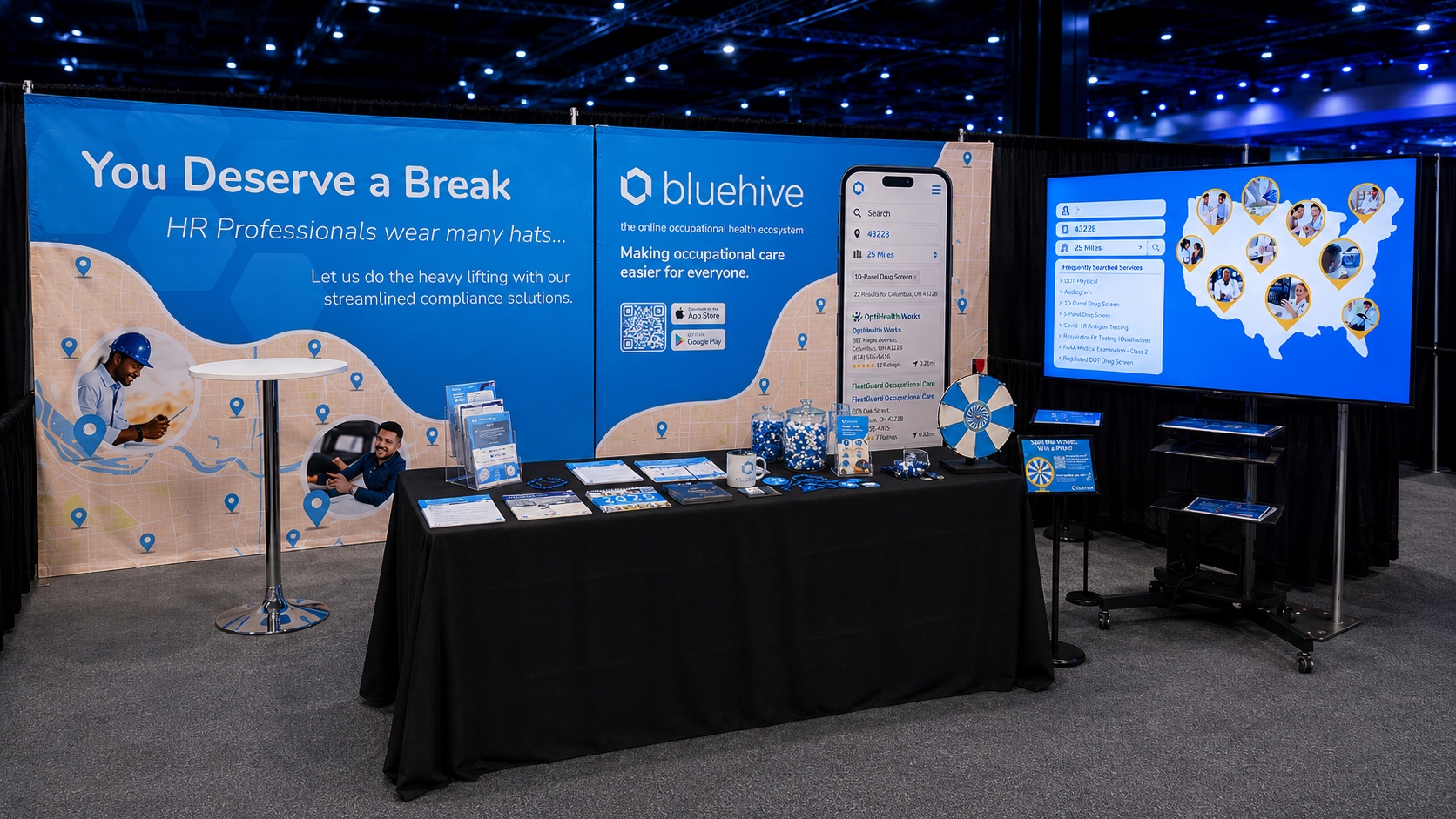
My role / Team leadership, messaging, graphic production, vendor coordination, and execution. Photograph from the existing project archive; photographer not established.
The case study distinguishes the work I directly built, the work I led, and patterns that other teams carried forward. Shared outcomes are not individual authorship.
I created the film from concept to final cut—writing the script, recording the voiceover, and designing and animating the video. The mobile product experience shown is also my design.
Engineering teams formalized the shared UI library and adopted public-web patterns in the core product rebuild. Those implementations belong to the teams that delivered them.
Follow the handoff.
BlueHive broadened how I think about experience design. The customer’s website and the employee’s administrative tool are not separate experiences when one person’s next step depends on the other.
Reuse matters beyond visual consistency. A useful pattern can give a publishing team a starting point, support a coordinator’s daily work, and become something another engineering team can extend. That is also why clear contribution boundaries belong in the story.
A service page needs a clear next step. A report needs room for evidence. A booth needs to start a conversation. The lesson is continuity without sameness: connect the work without forcing every medium into the same form.
Original working studies · Historical figures and commentary are retained, not a live operational feed or a new audit. Evidence labels and contribution boundaries remain attached to the work.
Repository scope update · 30+ as reported by Evelyna on September 23, 2026. References to 29+ below belong to the original study; its earlier audit labels do not establish a new audit of the updated count.